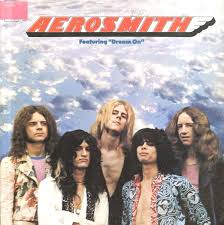
This will involve a few parts in a series concerning Aerosmith and their records. First record, Aerosmith: Featuring Dream On (Columbia, 1973). Strange to name a single for an album, but they did. “Dream On” didn’t become a hit until 1975. This album features a starving, hard working quintet living in practical squaller. There was no plan B. Plan A for the “boys from Boston” was make it, or nothing. Indeed, that’s one of their songs on this album.
Recording virtually “live” in the studio, you can hear a very tightly packed band that had refined these tunes to perfection. There’s your “10,000 hours to get good” theory lost on our current generation. Aerosmith was a blue-collar band. Guts, grit, blood, hard work, countless hours of repetitive playing and gigging. This was the work ethic of the past, and these boys had it. Have a dream? A vision? That’s going to require work, and not 40 hours a week, either. Stamina, stick-to-it-at-all-costs. You hear this in every tune on the record.
Steven Tyler, the front man, who admittedly copied the likes of Plant and Jagger, nonetheless bravely attempts his own crooning to be heard as a stand out performer. As mentioned, they start their debut with, “Make It,” which echoes the feature song, “Dream On.”
Good evening people, welcome to the show Got something here I want you all to know When life and people bring on primal screams You got to think of What it’s going to take to make your dreams
This is pure Cognitive Behavior Therapy. You have to think of what it takes to make your dreams:
Better weather, pull yourself together Don’t be catching the blues Better weather, pull yourself together What have you got to lose You’re only paying your dues
That has the stink of hard work all over it. There’s a bit of humiliation in those words as well. You could go down the rabbit hole that you are useless, a good for nothing, a train wreck, but why “catch those blues” (slips into depression) when you can “pull yourself together”? After all, since you have nothing, what have you got to lose? Pay your dues, and “make it.”
Returning to this theme, in the featured song, “Dream On,” we hear this:
Every time that I look in the mirror All these lines on my face getting clearer The past is gone Oh, it went by like dusk to dawn Isn’t that the way?
Everybody’s got their dues in life to pay, I know nobody knows Where it comes and where it goes I know it’s everybody’s sin You got to lose to know how to win
There is a biblical bases for this New England, Protestant “work ethic” mentality (Max Webber, anyone?). The Ozark Mountain Daredevils had a song, “If You Wanna Get to Heaven,” then you have to “raise a little hell,” which, interestingly enough, came out in 1973 as well. The idea of being at the bottom, where the only way is “up,” is the stuff of dreams and visions. Or, you can just wallow in the muck, play the victim, blame “the man” and such as your life spins pathetically out of control. Choice is yours, and yours alone.
There are some folks who love to point out “what’s wrong” with everyone. These are people who think they have it all together (even though they obviously don’t). They think they have a keen insight of others. As these “others” actually go on to accomplish their dreams, these ever-gloomy pessimists never accomplish anything except for constant arm-chair criticism.
Tyler and the band have a word for a person like this:
Whole earth lover, keepin’ undercover Never knowin’ where you’ve been You’ve been fadin’, always out paradin’ Keep in touch with Mama Kin
Indeed. Your life is fading, but you are out there parading, becoming the very thing you despise in others. Jesus called it, “hypocrisy.” For Steven Tyler, “Mama Kin” was life’s energy. If you fail to keep in touch with it, then you will fade. Dreams lost. Constantly decrying the accomplishments of others success, while you are fading in your own, isn’t keeping in touch. It’s a loser pointing out the winners and complaining about their earned winnings. Let that sink in. Life never gave you a break? Is that your excuse? You ain’t knowin’ where you’ve been.
Being painfully brief, let me switch to another aspect of this record. It’s a tight rhythm and blues recording. Whitford, Kramer and Hamilton keep a near perfect beat, while Perry, at least at this point, plays a clean guitar. There isn’t any high production here. This has “debut album” written all over it. You won’t hear anything on the wax that would become Aerosmith in the nineties in terms of production. Nevertheless, this was their first issued statement even though it fell flat on the critics’ ears. We heard it, the tee-shirt and blue jean mid-west heard it. The kids whose dads worked in the factories and farms heard it. And we liked it. I remember a friend of mine who related a story to me about showing his dad the album cover, which featured all five members. His dad’s response: “these people look like bums.” Bums with a mission, a dream, and a vision.
In the song, “Movin Out” we find this little repose:
Level with God and you’re in tune with the universe Talk with yourself and you’ll hear what you want to know Got to rise above ’cause below it’s only getting worse Life, in time, will take you where you want to go.
Here, again, we find the idea of “rags to riches” based on natural law. If you want something, then move and get it. What’s stopping you is only yourself. Of course, Aerosmith, having this work-ethic in mind (a Christian one, mind you), would become one of the worst examples of excess and indulgence ever imaginable. It’s one thing to work hard to get where you want to get, and another to reward yourself with the indulgences of sin once you get there. Start humble, remain humble. That’s the key. The Book of Ecclesiastes explores this all too human theme in spades (Al Pacino’s character, Tony Montana, blissfully displays it in Scarface). We work hard, we get what we want, then we blow it.
You can already hear this in the song, “Write Me A Letter”:
Well I’ve been away forever Suicide’s crossing my mind Well I’ll never, never, never, never, never Get so far behind
I said, the ways of the night are evil Without that Lord of Day But I’ll never, never, never, never, never Get so far away
Solomon, anyone? Already, Tyler’s “high” minded lyrics are foretelling what would become of the band within 6 years of this record. Abandon the “Lord of the Day” and you get what you get. “Level with God and you are in tune with the universe.” Indeed. But, this is what we forget, isn’t’ it? We need God to get there, we just don’t need God once we are there. We got it from here on out. Right? Wrong.
Final score for old time rockers like myself? Great record if you like early skip-on-the-digital-details music. Want to practice your chops? Definitely a metronomic practice record. Joey Kramer, the drummer, is as firm as any skin player can get. If you can play along with this on a guitar, a bass, or on drums, then you might “make it.” Just remember, you got to pay your dues. There are three “P’s” to success: Practice. Practice. And Practice. 10,000 hours. This is true in whatever you pursue.
Samuel M. Frost has gained the recognition of his family, peers, colleagues, church members, and local community as a teacher and leader. Samuel was raised in the Foursquare Gospel tradition and continued in the rising Charismatic Movement of the early 1980’s. While serving in local congregations he was admitted to Liberty Christian College in Pensacola, Florida where he lived on campus for four years earning his Bachelor’s of Theology degree. It was there under the tutelage of Dr. Dow Robinson (Summer Institutes of Linguistics), and Dr. Frank Longino (Dallas Theological Seminary) that he was motivated to pursue a career in Theology. Dr. Robinson wrote two books on Linguistics, Workbook on Phonological Analysis (SIL, 1970) and Manuel for Bilingual Dictionaries: Textbook (SIL, 1969). It was under these teachers’ guidance that Frost entered into his Master’s studies, being granted a scholarship for Greek I and II at Pentecostal Theological Seminary, accredited, in Cleveland, Tennessee (adjunct of Lee University). Frost completed his study under Dr. French Arrington (The Ministry of Reconciliation, Baker Books, 1980), who used the text of J. Gresham Machen, New Testament Greek for Beginners.
Frost studied Hebrew for two years under Dr. Mark Futato (author, Beginning Biblical Hebrew, Eisenbrauns, 2003) and Dr. Bruce K. Waltke (author, An Introduction to Biblical Hebrew Syntax, Eisenbrauns, 1990) at Reformed Theological Seminary, Orlando, Florida. With combined credits from PTS and RTS, Samuel completed his Master of Arts in Christian Studies and Master of Arts in Religion from Whitefield Theological Seminary in Lakeland, Florida under the direct tutelage of Dr. Kenneth G. Talbot, co-author of the well reviewed work, Hyper-Calvinism and Arminianism (Whitefield Media, 2005) with Dr. Gary Crampton (and Foreword by the late, Dr. D. James Kennedy). Dr. Talbot also oversaw Samuel’s Dissertation, From the First Adam to the Second and Last Adam (2012) earning him the Magister Theologiae (Th.M.) degree. He also helped put together A Student’s Hebrew Primer for WTS, designed and graded exams for their Hebrew Languages course.
Samuel’s studies lead him into an issue in the field of Eschatology where his scholarship and unique approach in Hermeneutics garnered him recognition. Because of the controversial nature of some of his conclusions, scholars were sharp in their disagreement with him. Frost’s initial work, Misplaced Hope: The Origins of First and Second Century Eschatology (2002, Second Edition, 2006 Bi-Millennial Publishing), sold over four thousand units. While arguing for the Reformation understanding of sola Scriptura as defined by the Westminster Confession of Faith, Frost’s book launched a heavily footnoted argument for a total reassessment of the doctrine known as the Second Coming of Christ. The conclusion was that the events of the war of the Jewish nation against their Roman overlords in 66-70 C.E. formed the New Testament authors’ eschatological outlook, and went no further than their own first century generation; a view otherwise known as “full” or "hyper" Preterism. Internationally recognized Evangelical author and speaker, Steve Wohlberg remarked, ‘On the “preterist” side today…we have such influential leaders as Gary DeMar, Kenneth L. Gentry, Jr., David Chilton, R.C. Sproul, Max King, James Stuart Russell, Samuel M. Frost, and John Noe. To these scholars…the beast is not on the horizon, he’s dead” (Italics, his)” (End Time Delusions, Destiny Image Publishers, 2004, page 133). It should be noted that only Noe, King and Frost supported the “full” Preterist position.
Thomas Ice and co-author of the best selling Left Behind series, Tim LaHaye, quote Frost’s work, Misplaced Hope, as well in their book, The End Times Controversy: The Second Coming under Attack (Harvest House Publishers, 2003, page 40). Dr. Jay E. Adams, who single handedly launched “a revolution” in Christian Counseling with his work, Competent to Counsel: An Introduction to Nouthetic Counseling, (1970, Zondervan), also wrote an analysis of Frost’s work in Preterism: Orthodox or Unorthodox? (Ministry Monographs for Modern Times, INS Publishing, 2004). Adams wrote of Misplaced Hope as a "useful, scholarly work" (p.6 - though he disagreed with the overall thesis). Dr. Charles E. Hill, Professor of New Testament and Early Christianity at Reformed Theological Seminary, Orlando, wrote of Misplaced Hope that Frost, “attacks the problem of the early church in a much more thoroughgoing way than I have seen” (When Shall These Things Be? A Reformed Response to Hyper Preterism, Ed. Keith Mathison, Presbyterian & Reformed Publishing, 2003, ‘Eschatology in the Wake of Jerusalem’s Fall’ p. 110-ff.). There were several other works as well that took the scholarship of Frost seriously, like Ergun Caner in The Return of Christ: A Premillennial Perspective, Eds., Steve W. Lemke and David L. Allen (B&H Publishing, 2011).
Because of the controversial nature of Frost’s conclusions on these matters, it was difficult to find a denomination within the Church-at-Large to work in terms of pastoral ministry. That situation changed when Samuel was called by a Bible study group in Saint Petersburg, Florida to found a congregation. Christ Covenant Church was established in 2002 operating under the principles outlined by Presbyterian historian James Bannerman’s work, The Church of Christ: A Treatise on the Nature, Powers, Ordinances, Discipline, and Government of the Christian Church (Banner of Truth Trust, 1974, original, 1869). By-Laws and a Constitution were drawn up in the strictest manner for what was considered an “Independent” establishment of an independent Presbyterian Church, granted that a “call” was received and recognized by Presiding Elders duly ordained from existing and recognized denominations. Two Elders, one ordained in the Reformed Presbyterian Church (Mike Delores), and another ordained in the Presbyterian Church of America (Dr. Kelly N. Birks, now deceased) tested and reviewed the call, ordaining Samuel on October 20th, 2002, the Twenty Second Sunday after Trinity. Proper forms were submitted to Tallahassee, Florida with the stamp of a Notary Public Witness. Christ Covenant Church (CCC) functioned as a local church for five years with a congregation as large as 30 members. Frost was gaining recognition after Misplaced Hope had been published in January of that year, and conferences were hosted that included debates with another prominent "full" Preterist educator, Don K. Preston. CCC hosted best-selling authors, Thomas Ice, and Mark Hitchcock from Dallas Theological Seminary; and Dr. James B. Jordan (Westminster Theological Seminary), well-known author/pastor in Reformed theological circles. Frost was invited for the next several years to speak at over 25 conferences nation-wide, was featured in articles and an appearance on local news in Tampa for one of CCC’s conferences. The Evangelical Theological Society also invited Samuel to speak at the Philadelphia conference (Frost is currently a Member of ETS as well as Society of Biblical Literature, SBL).
During this time Samuel had submitted one more book, Exegetical Essays on the Resurrection of the Dead (TruthVoice, 2008; repr. JaDon Publishing, 2010); and co-wrote, House Divided: A Reformed Response to When Shall These Things Be? (Vision International, 2010). Frost also wrote several Forewords for up and coming authors who were influenced by his teaching materials, as well as sited many times in books, lectures and academic papers (Essays is sited in Worship and the Risen Jesus in the Pauline Letters, Tony Costa, Studies in Biblical Literature, Volume 157, 2013 Monographs XV, Peter Lang: New York; "Unsound and Informally Fallacious Preterist Arguments for Mark 13:24-27." Elton L. Hollon, The Heythrop Journal, Volume 64, Issue 5, Sept. 2023). However, because of certain aspects of Hermeneutics and Frost’s undaunted commitment to scholarship (with always a strong emphasis on the personal nature of devotional living to Christ), several challenges to the "hyper" Preterist view he espoused finally gave way, largely due to the unwavering commitment to Samuel by the Dean of Whitefield Theological Seminary, Dr. Kenneth G. Talbot, who continually challenged him. In what shocked the "hyper" Preterist world, Samuel announced after the Winter of 2010 that he was in serious error, and departed the movement as a whole.
The documentation of Frost’s departure was published by American Vision’s Founder, Gary DeMar, with a Foreword by Dr. Kenneth L. Gentry. Why I Left Full Preterism (AV Publishing, 2012) quickly ran through its first run. The book was later republished under the arm of Dr. Kenneth L. Gentry (GoodBirth Ministries Publishing, 2019). Dr. Gentry also gave mention to Frost in his book, Have We Missed the Second Coming: A Critique of Hyper Preterism (Victorious Hope Publishing, 2016), noting him as "one of the most prominent" teachers within Full Preterism (135). Dr. Keith Mathison, Professor of Systematic Theology at Reformation Bible College in Sanford, Florida, endorsed the book as well. Samuel has gone on to write, Daniel: Unplugged (McGahan Publishing House, 2021); The Parousia of the Son of Man (Lulu Publishing, 2019); God: As Bill Wilson Understood Him: A Theological Analysis of Alcoholics Anonymous (Lulu Publishing, 2017). He is also active as a certified Chaplain with the Henry County Sheriff’s Department, Indiana, and enrolled with ICAADA (Indiana Counselor’s Association on Alcohol and Drug Abuse), and worked directly under Dr. Dennis Greene, Founder of Christian Counseling and Addictions Services, Inc., for a year. Frost’s passion is in the education of the local church on various issues and occasionally worked with Pastor Alan McCraine with the First Presbyterian Church in Lewisville Indiana (and at Knightstown Bethel Presbyterian - where he currently is a Member, and is a Commissioned Ruling Elder in the PCUSA), where he periodically was called upon to give the sermon. Samuel, with his wife, Kimberly, helped to establish Heaven’s Bread Basket food pantry that donates food items to local families in need once a month – a ministry of the Session of First Presbyterian Church (Lewisville). Frost has recently earned his doctorate in Theology (Th.D.) after two years with Christian Life School of Theology Global (CLSTG, Georgia). Currently, he is an Instructor for the Southern Region LIFE Bible College, Papua New Guinea, and recently was co-published with Elton Hollon for Bibliotheca Sacra (April-June 2023; Volume 180, Number 718; 202-227). He has a solid, family reputation in the community, and has performed local marriages and funerals. He also sits on the Board of the Historical Preservation Commission in New Castle, and Hagar's Hope, a women's transition house. Frost is employed as Instructor for the Henry County Health Department (Jail Recovery Assistance Program), teaching Cognitive Behavioral Therapy.
View all posts by Samuel M. Frost, Th.D.
One thought on “Aerosmith: Featuring, “Dream On.””
Bro! I couldn’t agree more! I love every song, and sang all the lyrics as a kid. I still play it and sing in the car. The catchy licks and beat hooked me and made Aerosmith my fav rock band in high school. But the lyrics sealed the deal. Unlike many bands up and coming, whose lyrics were crude a lewd, these were not. Thanks for pointing them out. But later Aerosmith lyrics did devolve.


 Vigilate et Orate
Bro! I couldn’t agree more! I love every song, and sang all the lyrics as a kid. I still play it and sing in the car. The catchy licks and beat hooked me and made Aerosmith my fav rock band in high school. But the lyrics sealed the deal. Unlike many bands up and coming, whose lyrics were crude a lewd, these were not. Thanks for pointing them out. But later Aerosmith lyrics did devolve.
LikeLike